
Bringing Stories to Life: My Journey Into an AI-Powered Art Project
By sharing, you're not just spreading words - you’re spreading understanding and connection to those who need it most. Plus, I like it when people read my stuff.
The Spark of an Idea
It’s amazing how some ideas sneak up on you. They don’t come as dramatic revelations or thunderous epiphanies, but rather as quiet whispers that grow louder with time. My idea for this project came from one such whisper, a simple observation that took root in my mind and refused to leave.
I was sitting in my office and found myself doing what I often do in moments of quiet: imagining stories.
The woman in the bright red coat—was she late for an important meeting, or perhaps rushing to meet a friend she hadn’t seen in years? The man juggling grocery bags—was he preparing a feast for his family, or simply trying to make it through another ordinary day? Each face I imagined became a character, each moment a scene in an unwritten play.
Then came the thought that changed everything: What if these stories could come to life? What if I could take the fleeting thoughts in my mind and give them form—not just in words, but in vivid, breathtaking images? What if others could do the same?
This wasn’t just a passing fancy; it was the start of something much bigger. I began to dream of a project that would allow anyone to create their own stories and see them brought to life in real time. It would be interactive, immersive, and deeply personal—an experience where imagination met technology to produce something truly magical.
But as exciting as the idea was, the path ahead was anything but clear. How could I bring such a vision to life? What tools would I need, and what obstacles would I face? The questions were endless, but so was my determination.
Conceptualizing the Project
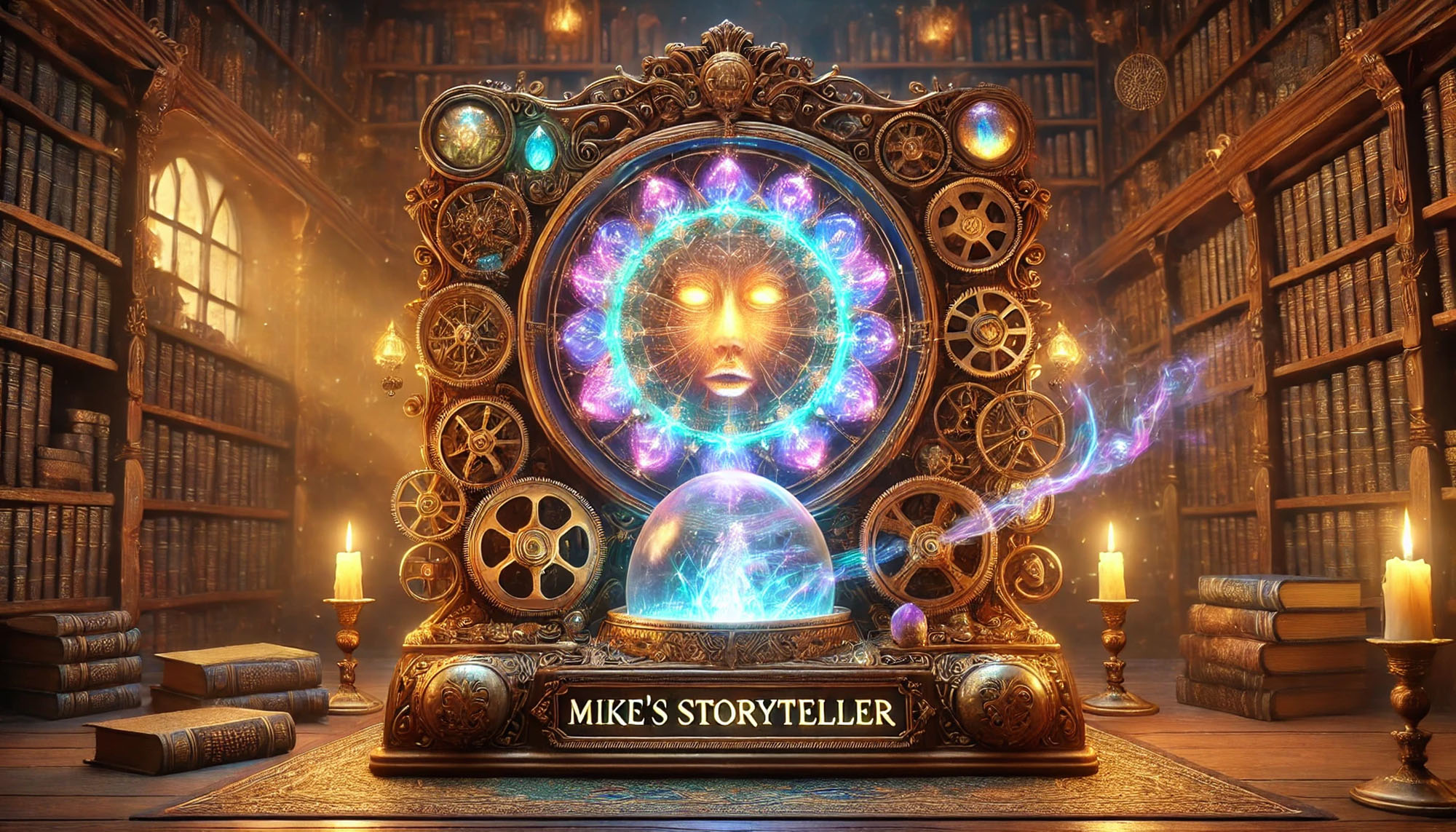
From the very beginning, I knew this project would be unlike anything I’d ever attempted. The idea itself was simple yet ambitious: an interactive system where users could describe a scene, emotion, or idea, and watch it come to life on two screens. One screen would generate a story, weaving a narrative from the user’s input, while the other would display AI-generated images that visually captured the essence of the story.
In my mind’s eye, the setup was elegant and seamless. A user would speak their thoughts aloud, and within moments, the screens would respond: a narrative unfolding on one side, and vibrant, evocative images appearing on the other. It would feel like stepping into a living, breathing piece of art.
But as anyone who’s ever worked on a creative project knows, turning a vision into reality is a journey fraught with challenges. My first step was to outline the core components of the system. I broke it down into three key elements:
User Input: A microphone interface that would capture the user’s verbal description. Story Generation: An AI model capable of crafting coherent and engaging narratives based on the input. Image Generation: A second AI model that would translate the narrative into stunning visuals.
This framework became my starting point, but I quickly realized that the devil was in the details.
Exploring the Tools
My next step was research. I delved into the world of artificial intelligence, exploring the capabilities of various tools and platforms. For the story generation component, I began experimenting with OpenAI’s GPT, a natural language processing model renowned for its ability to produce human-like text.
Early tests were promising but imperfect. When I prompted the AI with simple phrases like “Describe a quiet beach at sunset,” the results were poetic but lacked the emotional depth I was looking for. I knew I would need to fine-tune the model, teaching it to respond with richer, more nuanced narratives.
On the visual side, I explored tools like DALL·E and Stable Diffusion, which could generate images from textual descriptions. These platforms were capable of producing stunning visuals, but they often struggled with abstract or highly specific prompts. I began to realize that creating a seamless connection between the text and image models would be one of my biggest challenges.
Early Experiments
The first prototype was a fascinating mix of excitement and chaos. I set up a basic system where the user’s verbal input was transcribed into text, which was then fed into the story and image generation models. The results were… unpredictable.
One user described “a serene meadow at sunrise,” and the story generator responded with a bizarre tale about a magical goat and a talking tree. Meanwhile, the image generator produced something that looked more like an alien landscape than a meadow.
It was clear that the system had potential, but it needed a lot of refinement. I began tweaking the prompts I used to guide the AI, learning how to craft input that would produce more coherent and relevant outputs. Slowly but surely, the results started to improve.
The First Small Victories
After hours of trial and error, I experienced my first real breakthrough. A friend volunteered to test the system, describing “a cozy cabin in the woods during winter.” This time, the story unfolded beautifully:
"The cabin stood nestled among towering pines, its windows aglow with warm light. Outside, snowflakes danced in the wind, blanketing the forest in a hushed serenity. Inside, the fire crackled in the hearth as a family gathered, their laughter blending with the melody of the storm."
On the second screen, an image appeared: a snow-covered cabin framed by tall trees, with golden light spilling from its windows into the frosty twilight. For the first time, the system felt truly alive, producing results that were both cohesive and captivating.
That moment was a turning point. It wasn’t just a technical achievement—it was proof that the project was possible.
Building Toward a Vision
With the first glimmer of success, I felt a surge of motivation to keep refining the system. But the small victory of a functional prototype also revealed the depth of the work that lay ahead. While the cabin story and image were a success, subsequent tests were less consistent. The AI would occasionally veer off course, producing stories that felt disjointed or images that seemed unrelated to the text.
To address this, I realized I needed a better way to align the story and image generation models. While they worked independently, I wanted them to feel like two halves of a whole, producing outputs that complemented each other seamlessly. This meant diving deeper into prompt engineering and experimenting with different ways to structure user input.
One approach I tested was using the story as a bridge. Instead of feeding the user’s prompt directly into the image generator, I first allowed the story generator to craft a narrative and then used that narrative as the input for the visual model. The results were promising: the added context from the story often gave the images a greater sense of depth and coherence.
The Challenge of Creativity
AI is a remarkable tool, but it has its limitations. One of the biggest challenges I faced early on was teaching the system to handle abstract or creative prompts. While it excelled at straightforward descriptions like “a city skyline at night,” it struggled with more imaginative inputs such as “the feeling of hope during a storm” or “a world where time flows backward.”
These were the kinds of prompts that excited me most—the ones that pushed the boundaries of what the system could create. To tackle this, I began training the AI on datasets that included abstract and emotionally rich text. For the image generator, I curated examples of surrealist and conceptual art, hoping to inspire more creative outputs.
Progress was slow, but each improvement felt like a step closer to my vision. The AI began producing results that surprised me, not just in their quality but in their unexpected beauty. One test prompt, “a dream of floating islands,” resulted in a story that was hauntingly poetic and an image that felt like it had been plucked straight from a fantasy novel.
The First Functional Prototype
After days of work, I finally reached a point where the system felt functional. Users could speak a prompt into a microphone, and within seconds, the screens would respond with a story and image. It wasn’t perfect—there were still occasional glitches and inconsistencies—but it was enough to demonstrate the core concept.
Celebrating Progress
That evening felt like a milestone, not just for the project but for me personally. It was the first time I realized how the system could inspire creativity and connection. People won't be just passively observing—they will be engaging, experimenting, and sharing their ideas.
Tackling Inconsistencies
One of the biggest challenges I faced at this stage was consistency. While the system could produce stunning results in some cases, there were still moments when the outputs felt mismatched or uninspired.
To address this, I focused on refining the way the two AI models communicated. I developed a process where the story generator would include “visual cues” in its output—specific details that could guide the image generator more effectively. For example, a story about a forest might include phrases like “dense green foliage” or “sunlight filtering through the trees,” which the image model could use to create more accurate visuals.
This approach significantly improved the results. The stories and images began to feel more aligned, creating a sense of harmony that brought the project closer to its full potential.
Strengths of the System
By this point, the system has achieved several key milestones:
Interactive Storytelling: The AI could craft narratives that are not only coherent but emotionally engaging, sustaining up to 10 minutes of content based on user input. Stunning Visuals: The image generator produces visuals that are vivid, detailed, and often breathtaking, capturing the essence of the stories with surprising accuracy. Ease of Use: The microphone interface allows users to interact with the system naturally, making the experience feel intuitive and accessible.
Ongoing Challenges
Despite these successes, there were still areas that needed improvement:
Handling Abstract Prompts
While the system had made strides in handling creative inputs, there were still moments when it struggled with highly abstract or metaphorical prompts. Teaching the AI to interpret these nuances remained a work in progress.
Scaling the System The current setup works well for individual users, but I began exploring ways to adapt it for larger audiences. Could it function as an installation in a gallery or an online platform where multiple users could interact simultaneously?
Polishing the Interface While functional, the system still felt like a prototype. I wanted to refine the design to make it feel more like a cohesive piece of art, from the physical screens to the surrounding environment.
Finding the Balance Between Control and Creativity One of the most fascinating challenges I encountered during this phase was the tension between user control and the AI’s creative autonomy. On one hand, I wanted the system to feel intuitive and accessible—something anyone could use without needing a technical background. On the other hand, I didn’t want to limit the AI’s ability to surprise and delight users with unexpected outputs.
Take, for instance, a test prompt where a user describes “a city in the clouds.” The AI generated a poetic story about a futuristic civilization living among the skies, complete with floating gardens and shimmering towers. The image, however, might veer into abstract territory, depicting a surreal blend of colors and shapes that looks more like a dreamscape than a city.
The Highs and Lows of Creation Every creator knows that the path to realizing a vision is rarely smooth, and this project was no exception. For every breakthrough, there were countless moments of doubt and frustration.
I vividly remember one particularly challenging moment when nothing seemed to work. The story generator started producing repetitive, uninspired text, and the image generator developed a strange tendency to render everything in shades of neon pink. I spent hours debugging the system, only to end up more confused than when I started.
During those moments, it was tempting to question the entire project. Was it too ambitious? Was I chasing an idea that was impossible to fully realize? But each time I felt like giving up, I reminded myself of why I had started. This wasn’t just a technical experiment—it was a way to bring joy, creativity, and connection to others.
The Joy of Small Victories Amid the challenges, there were moments of pure magic that kept me going. I’ll never forget when I tried to described “a unicorn in a magical forest.” The story generator crafted a whimsical tale of friendship and adventure, while the images rendered a glowing unicorn surrounded by sparkling trees.
Scaling the project presented its own set of challenges. For one, I needed to ensure the system could handle multiple users simultaneously without losing its responsiveness. This required optimizing the AI models to run efficiently and exploring cloud-based solutions for scalability.
I also thought about the physical presentation. The two screens were already visually striking, but I wanted the entire setup to feel immersive. I imagined creating an environment that complemented the stories and images—a space with soft lighting, ambient music, and perhaps even interactive elements that allowed users to explore the outputs in more depth.
Incorporating Feedback One of the most valuable aspects of the development process will be user feedback. Every test session will provide insights into what works, what doesn’t, and what could be improved.
Conclusion: A Work in Progress As I reflect on this journey, I’m struck by how much I’ve learned—not just about AI and technology, but about creativity, resilience, and the power of pursuing an idea that feels impossible.
This project is still a work in progress, but every step forward brings me closer to realizing the vision that started it all: a system that bridges the gap between imagination and reality, turning thoughts into stories and stories into art.
For now, I’m focused on refining and expanding the system, but I can’t wait to see where this journey leads. More than anything, I’m excited to share it with others and see the incredible creations they bring to life.
0 Comments